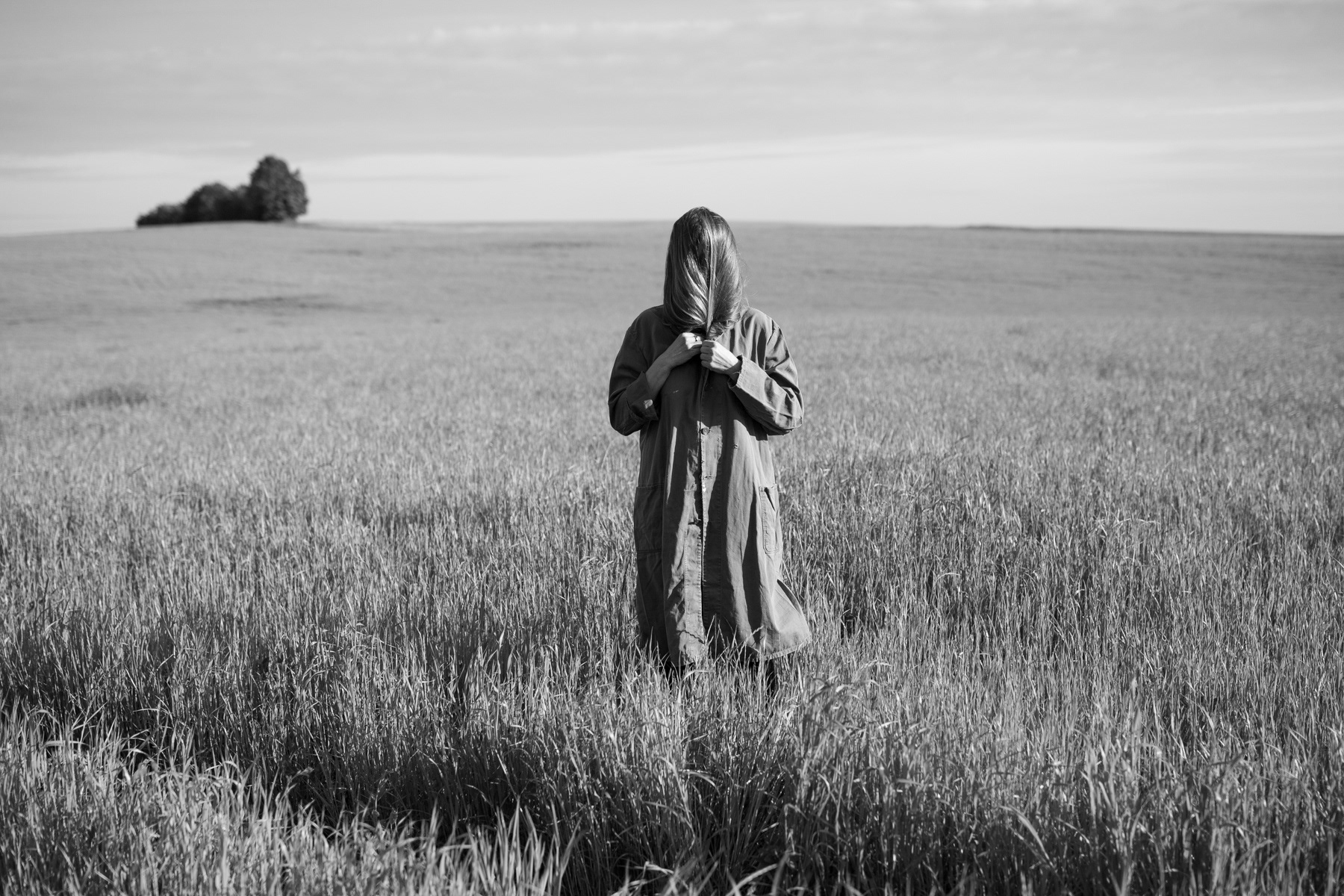
Velma Babić works across photography, video, performance, drawing, sound, and spatial installation. Using her own body as material and spatial presence, particularly in performance and photography, she develops works through gesture, repetition, and the shifting relation between figure, space, and perception.
Her practice often begins with simple actions — covering, carrying, sweeping, obscuring — repeated beyond their immediate purpose. Through repetition, these gestures gradually detach from function and become ways of negotiating presence and transformation. Figures emerge only partially, dissolve into landscapes, or remain as traces. Rather than approaching the body as a fixed identity, Babić understands it as a site where personal experience and broader social realities intersect.
Shaped by experiences of war, displacement, and migration, her work engages with the ways history continues to inhabit the present. Born in Hamburg, raised in former Yugoslavia / Bosnia and Herzegovina, and now based in Munich, her biography spans multiple geographies that continue to inform her attention to memory, continuity, and rupture.
Landscape, architecture, and transitional environments are active elements within the work. They absorb and reshape the figure, becoming part of an ongoing negotiation between presence and absence. Sound and material interventions extend these relations beyond the visible, opening spaces of resonance and tension.
Drawing occupies a parallel position within her practice. Here, personal and historical experience condense into reduced and often ambiguous visual structures. Emerging through repetition, erasure, and interruption, the drawings remain fragmentary and open.
Across media, Babić employs reduction not as an aesthetic end in itself, but as a way of approaching experiences that resist direct representation. Through minimal gestures, modest materials, and subtle shifts of perception, her works attend to what persists, often quietly, within bodies, places, and collective memory.